Mr. Spreadsheet

My friend Rick is the kind of person who insists on putting his card down for the frequent flyer points. He has solar panels on his roof, a subsidised battery on order, and his next car will be electric. Mention climate change and he won’t hesitate: global warming’s happened for billions of years, and besides, it’s all China’s fault. He scoffs at Greta Thunberg types and thinks I’m woke for trusting the science.
Rick is a good accountant. He didn’t install solar panels to save the Great Barrier Reef. He opened a spreadsheet, ran the numbers, and the payback period was six years. The battery cuts his evening peak charges in half; the EV saves him thousands a year in fuel.
In 1997, fossil fuels supplied roughly 86 percent of the world’s primary energy. Three decades and thirty UN climate summits later, the figure is 82 percent, and the world burns 55 percent more of them in absolute terms. They rose through Copenhagen, Paris, and Glasgow.
Since 1995, the United Nations has involved every sovereign nation on earth in the effort. In the same period, Chinese manufacturers reduced the cost of a solar panel more than 90 percent. One of these facts changed the energy system. The other produced communiqués.
The climate movement spent a generation treating decarbonisation as a persuasion problem. Change what people believe, and behaviour will follow. It doesn't work that way. Change the cost structure, and behaviour follows regardless of belief. As Paul Keating once said, always back the horse called self-interest. At least you know it's trying.
The activists achieved something, just not what they intended. Thirty years of advocacy created the political conditions for feed-in tariffs, research funding, and manufacturing subsidies that bent the cost curve. The moral case never changed Rick’s behaviour. But it changed the economics.
The Strait of Hormuz is thirty-four kilometres wide. Twenty percent of the world’s oil and a fifth of its liquefied natural gas pass through it daily. Since Iran’s selective blockade began, tanker transits have collapsed from over a hundred a day to twenty-one. Insurance premiums have jumped from one percent to five percent of vessel value.
Brent crude is $107 a barrel. Petrol is up ninety cents a litre in Sydney. Australia holds thirty-six days of petrol reserves and thirty-two of diesel.
Solar on the roof, a battery in the garage, and an EV in the driveway makes the Strait of Hormuz someone else’s problem. The family that installed panels to do the right thing and the family that installed them because the quarterly bill hit $900 reduce emissions just the same.
It’s the second rationale that scales.
The Pentagon reached the same conclusion through body bags. In Afghanistan, a gallon of fuel delivered to a remote forward operating base cost up to $400 once you accounted for the supply chain, the convoys, and the soldiers required to protect them. One soldier was killed or wounded for every twenty-four fuel resupply missions.
The world’s largest institutional fuel consumer began installing solar on forward bases, not because generals converted to environmentalism, but because fossil fuel dependence was killing their troops. The same logic as Rick. The casualty report demanded it.
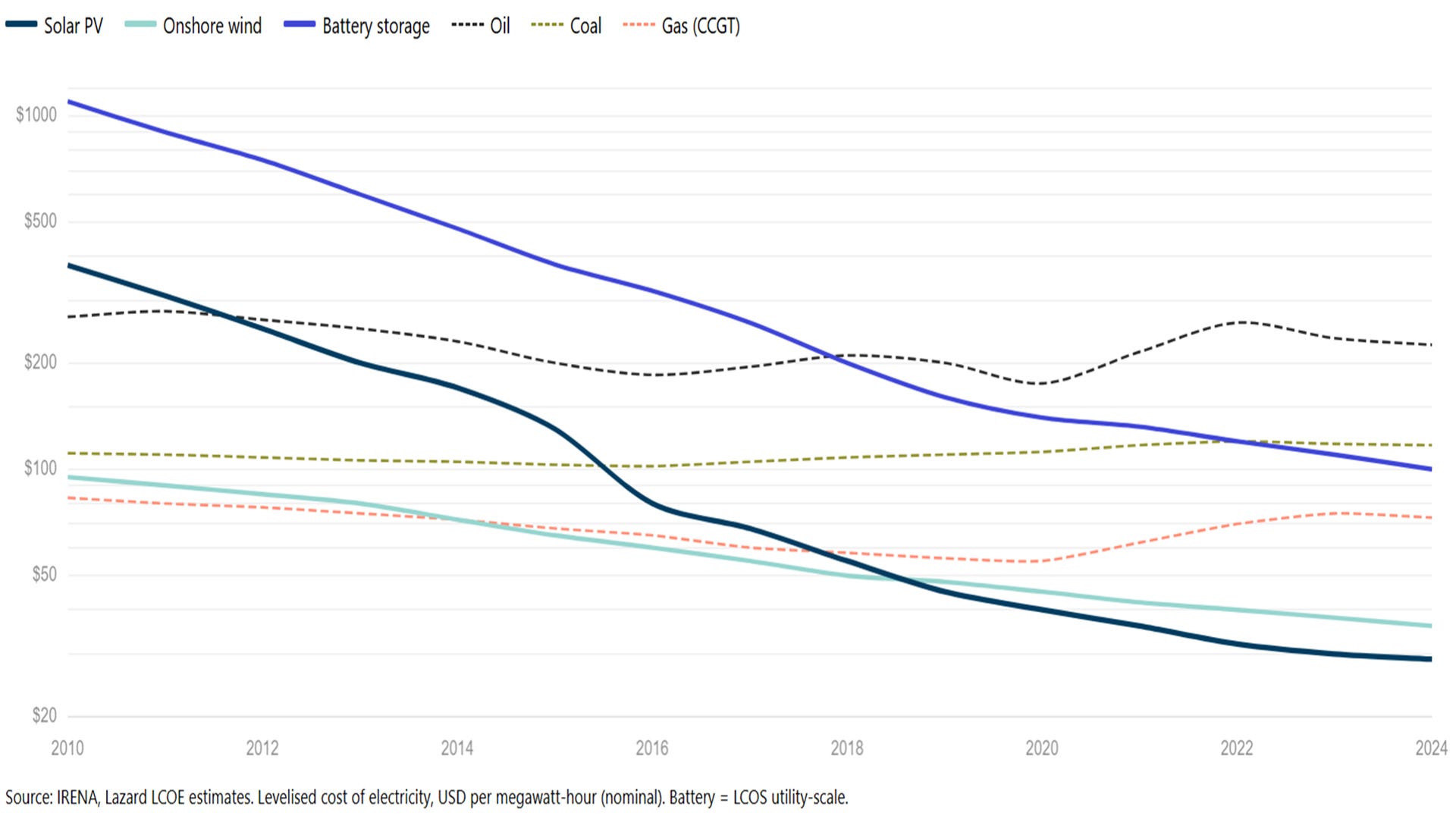
Rick will buy whatever is cheapest. If diesel generators were cheaper than batteries tomorrow, he’d buy a diesel generator. The 1970s oil shocks made Americans buy small cars. Cheap oil brought back the SUV. This time the cost curve has moved too far to snap back. Electric vehicles are approaching purchase-price parity with combustion engines. Battery storage costs have dropped roughly 90 percent in fifteen years. Solar electricity has fallen from $378 per megawatt-hour in 2010 to under $30 today. Once Rick installs that battery, he won’t uninstall it when petrol falls back to a buck sixty.
This is a ratchet, not a pendulum. Rick’s panels are generating. His battery goes in in a few weeks. His (Chinese) EV is on order. He still thinks climate change is bullshit. But his household carbon footprint will be lower than most who blocked traffic to demand what he’s already done.
The panels do not care what Rick believes. They just generate.
Luke Heilbuth is CEO of strategy consultancy BWD Strategic, and a former Australian diplomat. Connect with Luke on LinkedIn or reach out to him at luke.heilbuth@bwdstrategic.com
My favourite writer/thinker. Another great piece.